
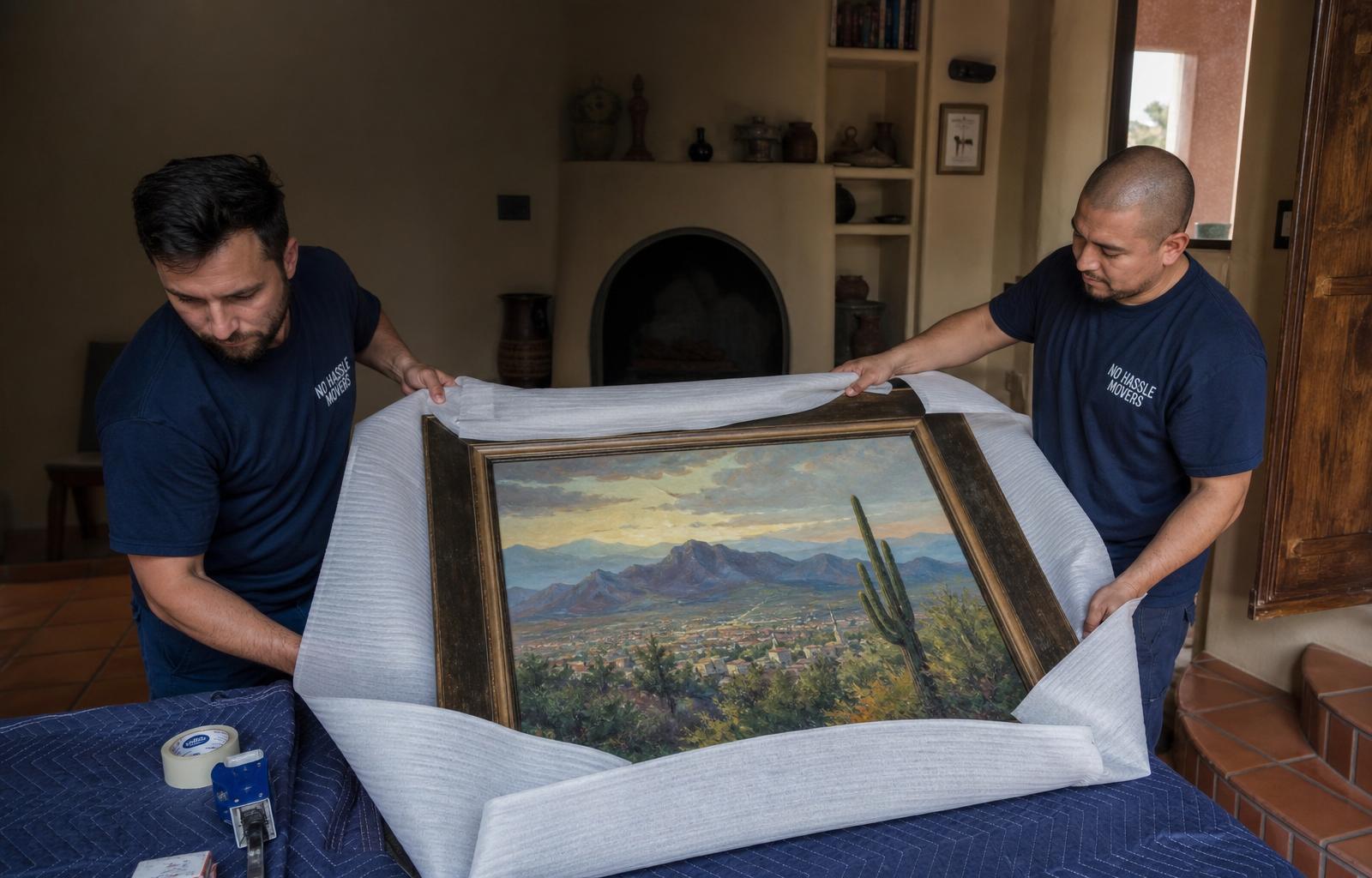
Some things in your home can't be replaced: a painting from your grandmother, a 19th-century dresser, a gilded mirror, a china cabinet full of family pieces. We move antiques and fine art across Tucson with the wrapping, boxing, and crating each piece needs. Most basic antiques and art move at our standard rate of $547 for the first 2 hours with the truck and crew, and pieces that need custom crating are quoted on their own after we see them.
Finding the Fragile and Valuable Pieces Before Moving Day
That oil painting your grandmother left you is valuable. So is the gilded mirror in the hallway you've walked past for years, and the hand-carved side table you found in a Fourth Avenue shop a long time ago. Most homes have more fragile and important pieces than people realize, until it's time to move them.
On an antique and art move, we start with a real walk-through of your home. Not a quick glance, and not a quote off a phone call. We walk the house with you and mark everything that needs special care, like:
- Oil paintings, watercolors, and framed photos behind glass
- China and porcelain, like figurines, vases, and decorative plates
- Antique furniture with delicate veneer, inlay, or original hardware
- Sculpture in stone, bronze, or mixed materials
- Stained or leaded glass and framed mirrors
We run into this often. Someone mentions an old dresser, we pull it out from the wall, and there are 1800s dovetail joints on the back. That changes how we move it. When it was made, how it was built, the finish, the type of glass in a frame: all of it matters.
It's rare to walk into a Tucson home without finding something worth extra care, especially in the Catalina Foothills, where walls are often hung with fine Southwestern art. A single piece can be worth more than everything else in the house combined, and our crew knows the difference.
We ask about sentimental value, too. If a piece could never be replaced, we treat it that way. Plain and simple. The walk-through often turns up things you'd forgotten, like the crystal chandelier over the dining table or a shelf of old books. Once we have the list, we build the plan around your pieces, not a one-size-fits-all routine.
What Antique and Art Moving Costs in Tucson
Most antiques and art don't need anything beyond careful wrapping and boxing, and those move at our standard rate: $547 for the first 2 hours with the truck and crew, then $127 an hour. A few framed prints, a dresser from grandma, a mirror, a small sculpture: most of that rides along at the standard rate, so you get a real number up front.
A 19th-century secretary desk with loose veneer is a different job. So is a six-foot canvas. Pieces that need custom crating or special preparation are quoted case by case after we look at them, because the prep is the work.
What Moves the Price Up or Down
- The value and type of the piece. A signed original gets a different plan than a reproduction, usually with more protection, more time, and a second set of hands.
- Custom crating. A built-to-size wooden crate takes materials and labor, and it's the single biggest cost driver.
- Special preparation. Marble tops come off bases, glass doors come out of case pieces, and loose veneer or a fragile frame gets faced and padded before anything touches it.
- Size and weight. An 8-foot canvas or a heavy armoire needs more movers and more truck space.
- Access. Narrow stairwells, tight landings, elevators with low ceilings, and long carries from the curb all add time.
What brings it down: fewer pieces, clear paths at both ends, ground floor to ground floor, and pieces that travel well wrapped and boxed instead of crated. If the number feels high, tell us. Sometimes the answer is crating only the pieces that truly need it and wrapping the rest the standard way.
We look at every piece before we quote, in person or from photos and videos you send, and that's free. Once we've seen your items, the price we quote is the price you pay. Add a piece or a service, and we update the quote before the truck rolls. If you'd rather not send photos or schedule a visit, we can work hourly instead.
A quick phone quote from someone who never saw the piece can look lower than ours. Our number is built on the crew, the truck, and the materials the job actually needs, and it holds.
What's Included, and What Isn't
At our standard rate, you get:
- Careful wrapping, plus moving blankets and stretch wrap on furniture and case pieces
- Custom boxing for mirrors and artwork, and TV boxes if televisions are in the same load, included in a flat-rate quote (on an hourly job, they're added as supplies)
- A designated loader who builds the load for weight distribution, with ratchet straps so nothing shifts
- A walkthrough with you on arrival to confirm everything matches what we reviewed
- Placement in the room you want, and a final check with you before we leave
There's no trip fee and no call-out charge, because truck and travel are built into the 2-hour minimum or your flat rate.
Quoted separately:
- Custom crating and special preparation. A built wood crate takes measuring, materials, and build time. If a piece needs one, we tell you before you book, not on moving day.
- Unpacking. We'll do it if you ask, but it isn't assumed.
We don't move hazardous materials or haul general junk like trash or yard waste. We will haul away old furniture and appliances, and we handle donation drop-offs.
Here's the part other quotes often leave out. If something is damaged, our first step is to repair it. If it can't be repaired, reimbursement is the industry standard of 60 cents per pound per article, which is $60 on a 100-pound piece, no matter what the piece is worth. For a signed painting or a great-grandmother's secretary desk, that doesn't come close to the real value. That's why we'd rather spend an extra hour crating a piece than settle a claim on it, and why we suggest talking to your insurance agent about separate coverage for high-value pieces before moving day. We carry $1 million in general liability, but that's a different thing from valuation on your individual items.
If a piece is already fragile, like flaking paint or lifting gilt, a professional conservator may want to stabilize it before it travels. The National Archives has a helpful guide on how to find a conservator.
Professional Movers vs. a DIY Move for Antiques and Art
Maybe you've thought about doing it yourself: rent a truck, grab some blankets from the closet, and hope for the best. We often hear from people who tried that and ended up with a broken frame or a shattered figurine before they ever left the driveway.
The problem isn't time or effort. Antiques and art just don't move like regular furniture.
An 1800s oak chest of drawers feels solid, but its joints can be loose and its veneer brittle. Oil paintings expand and contract with heat, and a closed truck on a Tucson summer afternoon can climb past 150 degrees inside. Gilt frames warp. Glass can crack from road vibration alone, without ever being bumped.
A DIY move won't teach you:
- How to plan around the Arizona summer heat from pickup to delivery
- How to build and pad a crate sized to each piece
- Where an antique is weak, like a fragile corner or a loose joint, and how to lift around it
- How to keep every piece completely still in transit
That marble-topped table that looks so sturdy? The top often isn't attached at all. It just sits there. Pick the table up by the wrong part, and the top slides. And if you damage your own piece on a DIY move, there's no coverage at all.
We move antiques and art in homes all over the Catalina Foothills and Sam Hughes, where nearly every collection has a history. We're insured, we have more than 20 years of moving experience, and we give you a flat rate with no call-out fee and no surprise bill later. Call for a free estimate. A real person with moving experience answers, not a call center or a machine, and you'll know in a few minutes whether we're the right fit.
How We Prep Antiques and Art
Moving day is here. There's a 200-year-old dresser in the living room and a framed oil painting from your grandmother on the wall. Now what?
Most people don't realize that the real damage to antiques and art usually happens before anything gets on the truck. It's rarely a bump on the road. It happens during wrapping: the wrong tape on a gilded frame, or a moving blanket wrapped straight onto a finish with no barrier layer underneath. That's why our crew does all the prep on site.
What We Do Before Anything Gets Lifted
- We photograph and document each piece, including existing scratches, patina, and wear. That protects you and gives us a clear record of how it looked before the move.
- We remove hardware, glass, and any parts that come off, then label and bag them. They stay with us until they're back in the right spot.
- We wrap first in acid-free tissue, then add padding sized to each piece. Packing peanuts never touch bare wood, canvas, or any finished surface.
- We use mirror boxes for framed pieces and build custom crates when a piece needs one. Flat cardboard and standard boxes aren't strong enough for pieces that can't be replaced.
- We plan the route and the timing, so pieces spend as little time in the heat as possible. Tucson summer heat can warp wood and soften old adhesives, so we schedule around the worst of it.
People near the Catalina Foothills sometimes ask, "Why can't I just wrap it myself?" You can, but we'd likely have to rewrap it with the right materials. Newspaper ink rubs off and stains porous surfaces, and bubble wrap alone can still let a corner punch through to the finish. Small mistakes add up fast.
If a piece needs special prep or a crate, we'll know during your free estimate, online or in person, with no trip fee. We check dimensions, fragility, stairs, and hallway widths so your flat rate is accurate and nothing changes when we unload. Not sure if your piece needs extra prep? Call. A real person with moving experience will answer.