
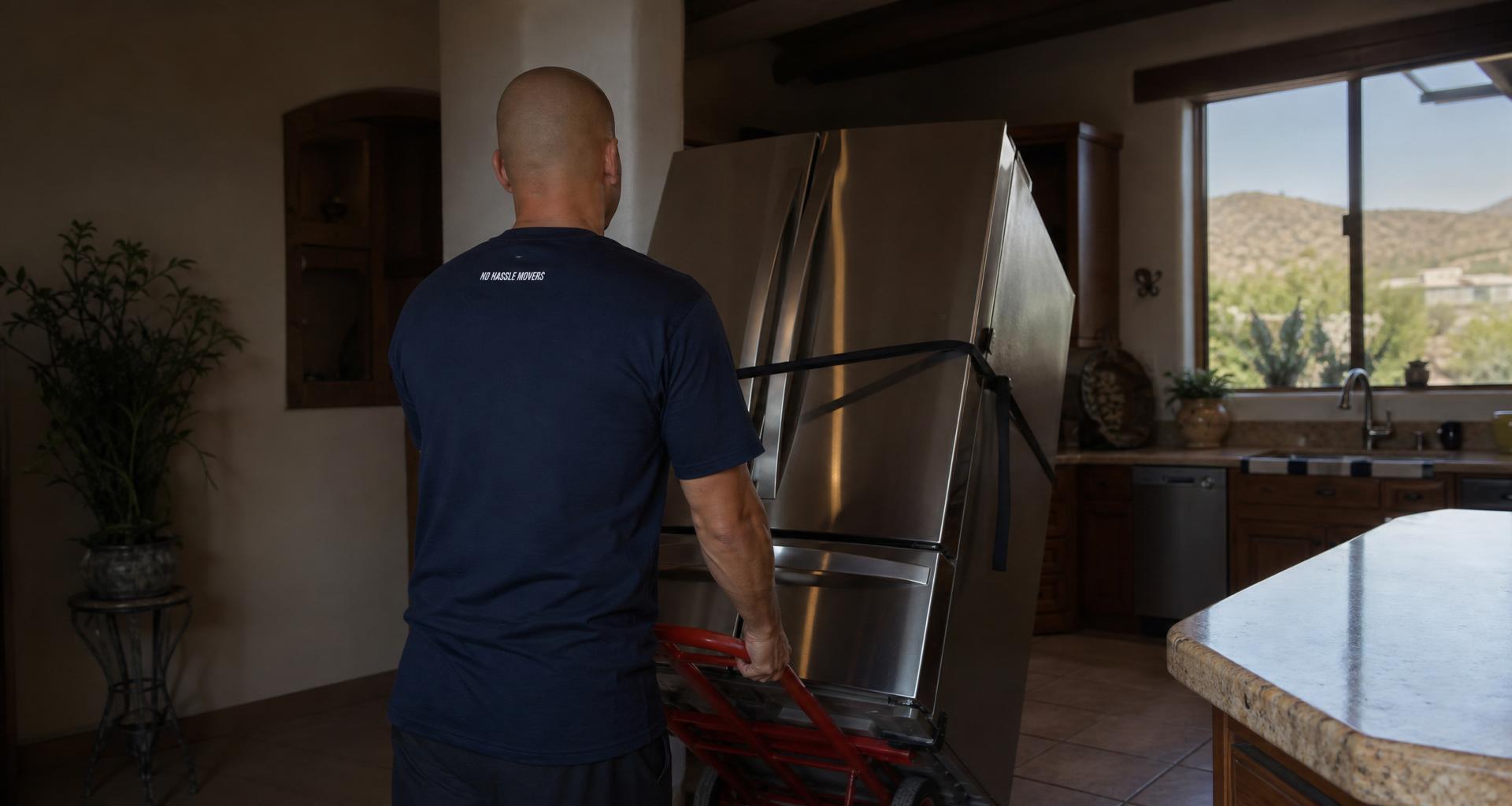
Refrigerators, washers, dryers, ranges, and freezers are heavy, awkward, and often tied to a water line or a gas line. We move them across Tucson with the right dollies, straps, and crew size, and we tell you exactly what needs to be disconnected before we arrive. Moving an appliance from one home to another with our truck usually runs $547 to $797, and the flat rate is locked once we've seen the job.
Signs You Need Professional Appliance Movers
Your body is usually the first to warn you. The fridge is too heavy, the washer has no room to turn in the laundry closet, and the range has a gas hookup you don't want to touch. That's when moving an appliance stops being a chore and becomes a real risk.
We regularly hear from people who tried to muscle a dryer down a hallway and gouged the walls, or hurt themselves doing it. Here's how to tell it's time to call a crew:
- The appliance weighs 200 pounds or more. Most refrigerators, washers, and ranges do.
- There are stairs, corners, or narrow doorways between the appliance and the truck.
- There are gas, water, or electrical connections that need to be shut off properly.
- Your floors are tile, hardwood, or anything that scratches easily. One bad move can mean an expensive repair.
- You don't have appliance dollies, straps, or a way to protect the floor.
One more that people overlook: the heat. Moving a 300-pound fridge on a summer afternoon, when the air can pass 110 on the hottest days, is hard on anyone. In neighborhoods like Sam Hughes and Armory Park, appliances often have to travel down a long driveway or through a gate before they even reach the truck, then through small doorways, down steps, or up to a second-floor condo or apartment.
Most people figure they can handle it themselves. But a scratched hardwood floor or a torn ligament usually costs more than hiring a crew. We bring the right equipment and over 20 years of moving experience, we're insured, and once we've seen the job, the price we quote is the price you pay.
What Appliance Moving Costs in Tucson
Most appliance jobs come in between $347 and $797. Here's where yours is likely to land:
- A fridge, washer, or dryer going to another home with our truck: $547 to $797 for most appliances.
- Staying on the same property: $347 to $647. Think garage to laundry room, or first floor to second. It depends on how many movers it takes.
- Riding along with a bigger move we're doing for you: it's part of your move quote and costs less on its own terms, usually adding $247 to $647.
Got your own truck? There's no truck charge. Our labor-only rate starts at $347 for the first 2 hours, and it goes up if the appliance or the path needs more movers.
What Moves the Price Up or Down
- The size and weight of the appliance. A standard dryer and a commercial-size refrigerator are different jobs, even in the same kitchen.
- How many movers it takes. Some appliances are a two-person job. Others need three or four.
- Stairs. A second-floor laundry room changes the work more than almost anything else.
- Doorways and gates. Tight clearances can mean taking a door off its hinges, removing the appliance's doors, or both.
- The path to the truck, like gravel, a long side yard, or a slope.
Weight matters, but it isn't the whole story. A 250-pound fridge around a tight stair landing can take more work than a heavier item down a straight hall. Two washers that weigh the same can cost different amounts when one rolls out a wide garage door and the other goes down a narrow stairwell with a turn at the bottom. A phone description rarely catches that turn.
So we see it before we put a firm number on it. Photos, a short video, or a free visit all work. From there, your flat rate is guaranteed. Want to add the second fridge in the garage, or have us haul the old washer away? We'll update the quote and show you the new number before we start. If you'd rather skip the photos, we can work hourly with a 2-hour minimum. That can make sense for a small same-property job, but it won't give you a locked number up front.
What's Included, and What Isn't
Your price includes:
- The right crew size for the appliance and the path
- Appliance dollies, straps, and the equipment for the doorways and turns on your route
- Moving blankets and stretch wrap on the appliance, with protection for door frames and floors when required
- Loading with the weight balanced and ratchet straps so nothing shifts on the drive
- Placement in the spot you want, unwrapped, before we leave
- A final walkthrough with the crew while we're still there
There's no trip fee or travel charge. The truck and travel are part of the flat rate or the 2-hour minimum. A last-minute call, a Saturday, or a holiday doesn't change the number.
What we don't do: we're movers, not appliance technicians or plumbers.
- We don't unhook or hook up appliances. Water lines and gas lines have to be disconnected before we arrive, and that's the homeowner's responsibility. You can do it yourself or hire whoever you prefer, like the gas company or a licensed professional. The same goes for the hookup at the new home.
- If an appliance only needs to be unplugged from a wall outlet, like an electric dryer, we can do that for you.
- Defrosting the fridge is on you, and it takes longer than people think. More on that below.
- We don't move hazardous materials or haul general junk like bags of trash or yard waste. We will haul away the old appliance your new one is replacing, and we handle donation drop-offs.
If something does get damaged, our first step is to repair it. If it can't be repaired, we reimburse at the industry-standard 60 cents per pound per article. On a 200-pound appliance, that's $120. You should know that number before you book, not after.
Gas Appliances Need Special Handling
We bring this up on almost every appliance call. Someone asks us to move a dryer or a range, and it turns out to be gas. That changes the job.
You can't just unplug a gas appliance and roll it down the hall. The gas has to be shut off and the line disconnected and capped first, by someone qualified to do it. Done wrong, even a small leak in a closed-up house in the middle of a Tucson summer is a real danger.
What Happens Before a Gas Appliance Moves
- We ask whether the appliance runs on natural gas or propane, since the process is different.
- The gas has to be shut off, disconnected, and capped before moving day. That's the homeowner's responsibility, and most people have the gas company or a licensed professional do it.
- Once the line is safely disconnected, we check that loose cords and lines are secured to the appliance.
- At the new home, we set the appliance in place, ready for whoever you choose to connect it.
In Tucson, a lot of people call Southwest Gas or a licensed professional. Old flex lines are worth a look, too. On one gas dryer in the Catalina Foothills, the flex line had deteriorated so badly it was crumbling. We flagged it so the customer could have it replaced instead of reused.
Don't forget the water heater. It's big, heavy, and awkward, it holds water even when you think it's empty, and it needs to be disconnected and drained before moving day, by you or someone you hire. We'll handle the heavy lifting once it's ready.
After more than eight years of moving appliances around Tucson, we know what to look for and what can go wrong. Not sure whether your range is gas or electric? Call, and we'll help you figure it out on the spot.
Getting Ready for Moving Day With Your Fridge and Washer
Moving day is tomorrow, the freezer is full, and the washer still has water in it. Here's what to do.
Do it the night before. You don't need to be handy. You just need to know where to start, and customers who prep ahead have the easiest moves.
Refrigerators
Unplug the refrigerator and freezer the day before, at least 12 hours ahead, so everything can thaw and you don't end up with puddles on your floor, in the truck, or at the new house. Take out all the food and the freezer contents. Remove loose shelves and drawers, wrap them in towels, and keep them nearby, because they're the parts that break most. Empty the drip pan underneath if you can reach it, and tape the doors shut with painter's tape so they don't swing open.
If your ice maker has a water line, shut off the water first, then disconnect it and let it drain into a bucket. In Sam Hughes, we once watched a water line spray across a customer's hardwood entry because nobody shut it off first. Don't skip that step.
At the new house, check your owner's manual before plugging the fridge back in. Many manufacturers want it standing upright for a few hours first, and a fridge in a hot Arizona garage has to work hard to cool down.
Washers and Dryers
Run an empty spin cycle the night before to clear water from the drum and hoses. Shut off the water, disconnect the supply hoses, and drain them into a shallow pan or an old towel. Leave the lid or door open overnight so the inside dries. Here's the tip most people miss: if you still have the shipping bolts that came with the washer, put them back in. They lock the drum in place so it doesn't get damaged in transit. If you don't have them, tell us when you call, and we'll plan for it.
Quick checklist:
- Unplug and defrost the fridge at least 12 hours ahead
- Remove and wrap shelves and drawers
- Shut off and disconnect water and ice-maker lines
- Run an empty spin cycle on the washer
- Reinstall the washer's shipping bolts if you have them
None of this takes more than about 20 minutes, and it saves a lot of stress. Not sure about something? Tell us when you book, and we'll go over the prep with you.
Need help with Appliance Moving?
(928) 832-6683 — Get My Free Estimate. No Hassle Movers is ready to help.
How Our Crew Moves Appliances
Here's what happens when we arrive:
- We walk the path first. We trace the route from the appliance to the truck and look for obstacles, like a narrow hallway, a tight door frame in an older midtown house, or steps out back. We measure and plan before anything moves.
- We prep and confirm. We check that the fridge is defrosted and the water and gas lines are already disconnected. If an appliance only needs to be unplugged from the outlet, we take care of that.
- We protect your home. Moving blankets go around the appliance, and floor runners and corner guards go down when required.
- We use the right tools. Appliance dollies and straps, and a liftgate truck when a job truly calls for one. No sliding, no tipping, and no winging it.
- We secure the load. Appliances ride upright and strapped tight, so nothing shifts.
- We deliver and place. The appliance goes exactly where you want it, set level and ready for your hookup.
It's not complicated. The problems come when people try it alone, like a fridge that won't clear the kitchen island halfway out, or a washer tipped on its side until the drum is out of balance. Those aren't small problems. They're expensive ones.
If the appliance is part of a bigger job, it falls under our heavy and specialty item moving, along with a piano, a hot tub, a gun safe, or a home gym. Want to talk through your situation? Call, and we'll go over the specifics in real time.
Tucson Heat and Narrow Doorways
You've thought about the weight, but what about the heat? A fridge or range left sitting in the sun in a driveway or an open truck can take a beating. Door gaskets, plastic handles, and control panels don't like long stretches in Tucson's summer sun. We plan every appliance move to limit that exposure.
Our crew works quickly without rushing. Appliances stay inside, out of the heat, until it's time to load them. We cover them with moving blankets so the sun isn't hitting them directly, and we load them where they can come off first at the other end.
Doorways are the other challenge. Homes in Sam Hughes and the Catalina Foothills can have narrow entries, tight hallways, and sharp turns that were never designed for a modern appliance. A 36-inch French-door refrigerator won't fit through a 32-inch doorway without a plan. Here's how we handle tight spaces:
- We measure every door, hallway, and corner before we start.
- We take doors off their hinges when that frees up the inches we need.
- We remove appliance doors or handles to shrink the unit, when needed.
- We use heavy-duty appliance dollies and straps for raised entries and stairs.
It comes down to knowing the appliance, knowing the house, and using the right technique. Moving into a second-floor unit? We do plenty of apartment moves, too. If you'd like us to look at your place before you book, reach out. Estimates are free.
Deposit, Financing & Discounts
A deposit, typically $150 for most local and specialty-item jobs, holds your date, your arrival window, and your crew, and it comes off your final bill. Larger long-distance or packing-heavy moves run higher.
Financing is available, and it doesn't change your quote. It tends to help most when a standalone appliance move wasn't in this month's budget, when you're moving a fridge plus a washer and dryer at once, or when a remodel already used up the money you set aside.
Check the discounts first, though. Military members, veterans, first responders, healthcare workers, teachers, seniors, and students can all ask about our community discounts. Sometimes that brings the price down enough that financing isn't needed. We'd rather you pay less than pay longer.
Need it done fast? Our last-minute moves run on the same rates. Moving the rest of the house, too? Our furniture moving crew can take the couch and beds on the same trip. We move appliances all over Tucson and out to Oro Valley and Marana. At No Hassle Movers, we look first and quote what the job takes, and the quote holds. Here's how we price every move.
Frequently Asked Questions
How much does appliance moving cost in Tucson?
Most appliance moves run $347 to $797. Moving a fridge, washer, or dryer to another home with our truck is usually $547 to $797, moving one within the same property with no truck is $347 to $647, and adding it to a bigger move usually adds $247 to $647 to that move quote. With your own truck, there's no truck charge, and our labor rate starts at $347.
Do you disconnect gas appliances?
No. The gas has to be shut off, disconnected, and capped before moving day, and that's the homeowner's responsibility. Most people use the gas company or a licensed professional, and the same goes for connecting it at the new home. We ask whether it's natural gas or propane, flag issues like a worn flex line, and handle the heavy lifting once the line is safely disconnected.
Do you hook up the washer or fridge at the new house?
No. We move appliances, but we don't unhook or hook them up. Water and gas lines need to be disconnected before moving day, by you or a professional you choose, and the same goes for the hookup at the new home. If an appliance just plugs into a wall outlet, we can unplug it for you. We set it exactly where you want it, level and ready.
What should I do to my refrigerator before you arrive?
Unplug it at least 12 hours ahead so it can defrost, and take out all the food, shelves, and drawers. Wrap loose shelves in towels, since they break more than any other part. If you have an ice maker line, shut off the water, disconnect it, and drain it into a bucket. Tape the doors shut with painter's tape.
Can you move a refrigerator or washer up stairs or into a second-floor apartment?
Yes. We handle stairs, narrow doorways, and tight corners in condos and apartment buildings all over Tucson. We bring heavy-duty appliance dollies and straps and plan the route before we lift. If your building has an elevator with size limits or a stairwell with a tight turn, tell us ahead of time.
Does moving a water heater require anything special?
Yes. A water heater has to be disconnected and drained before it can be moved, and that's on the homeowner, whether you do it yourself or hire a professional. It's heavy and awkward, and it often holds water even when you think it's empty. Once it's ready, we handle the heavy lifting.
Will you haul away my old appliance?
Yes. We'll remove and haul away the old appliance your new one is replacing, and we handle donation drop-offs. Just tell us when you book so it's in your quote. We don't haul general junk like trash or yard waste.
What happens if something gets damaged during my move?
We're insured, and we protect your appliance and home along the way. If something does get damaged, our first step is to repair it. If it can't be repaired, we reimburse at the industry-standard 60 cents per pound per article. The price we quote up front is also the price you pay at the end.
Related Services
The full hub for oversized, heavy, and specialty item moving in Tucson.
Careful handling of heavy, bulky, and specialty furniture pieces.
Safe, careful relocation of gun safes up to 1,000+ pounds.
Treadmills, ellipticals, home gyms, and heavy weight racks moved safely.